 ultimate-guide
Benefits of Solar-Powered Gate Openers: A 2026 Guide
Table of Contents
- How Solar-Powered Gate Openers Work
- Solar Panels, Battery Power, and Off-Grid Operation
- Solar-Powered Gate Opener Pros and Cons
- Solar vs. Electric Gate Opener: Key Differences
- Solar Gate Opener Sunlight Requirements and Panel Placement
- Solar Gate Opener Battery Backup and Reliability
- Operating-Cost Savings and Total Cost of Ownership
- Installation, Sizing, and Troubleshooting
- Frequently Asked Questions
Last Updated: October 17, 2026
How Solar-Powered Gate Openers Work
A solar-powered gate opener is an automatic gate system powered by energy from the sun rather than grid electricity. Solar panels capture sunlight and convert it into electrical power that operates the gate's motor mechanism, eliminating the need for traditional wiring to your home's electrical system.
Photovoltaic panels mounted on or near the gate frame absorb sunlight throughout the day, charging an onboard battery bank. When you trigger the gate via remote, keypad, or motion sensor, stored energy powers the motor.
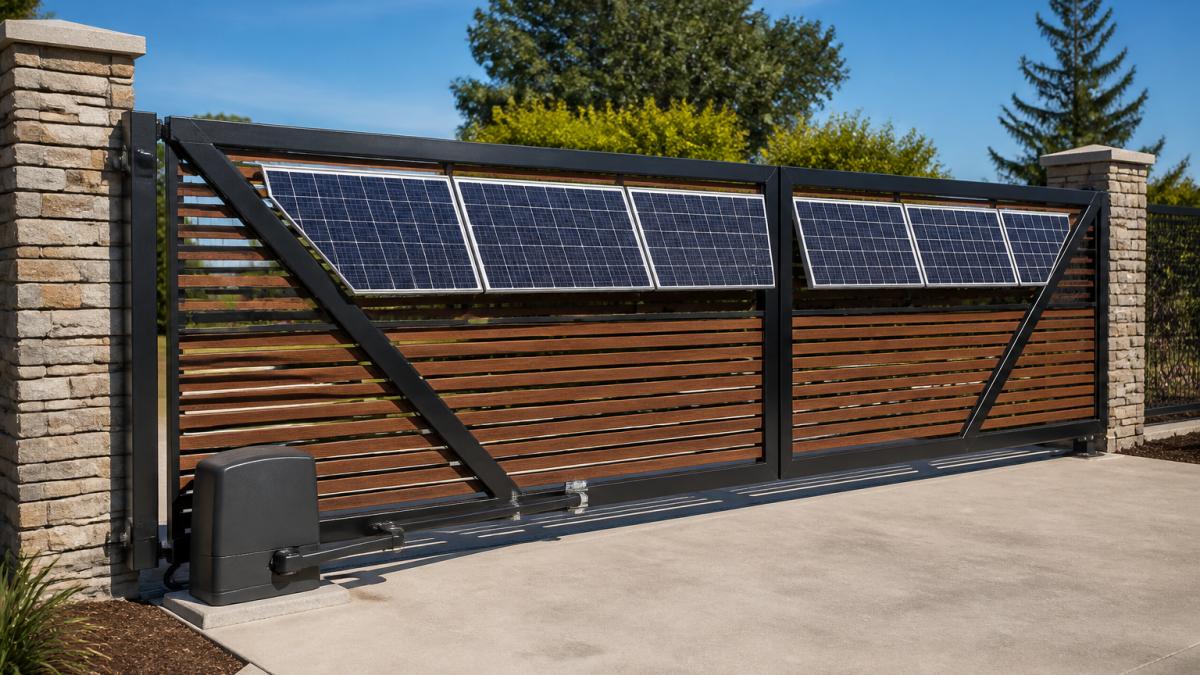
Most residential systems include a control board that manages power distribution and prevents overcharge. The self-contained setup installs far more easily than wired gates requiring trenching and permanent electrical connections. For rural properties or long driveways where running electrical lines would be prohibitively expensive, solar-powered gate openers eliminate that barrier entirely.
The appeal is independence from grid infrastructure: your gate operates the same whether connected to municipal power or entirely off-grid.
Solar Panels, Battery Power, and Off-Grid Operation
A typical residential solar-powered gate opener uses one or more panels rated 50 to 100 watts, depending on gate size and usage frequency. These panels convert sunlight into DC electricity during daylight hours, powering the gate directly or charging the battery.
Battery capacity deserves careful thought. A standard lithium or lead-acid bank typically ranges from 50 to 200 amp-hours, depending on daily gate cycles: moderate traffic might mean 20-30 cycles daily, a remote cabin only a handful. Size the battery to handle your usage pattern plus several days of reduced sunlight.
Off-grid operation is the defining advantage: once installed, a solar-powered gate opener draws zero electricity from the grid. That matters most beyond utility lines, where running power would cost thousands in trenching and electrical work, and during outages, when your gate keeps operating while grid-dependent systems fail.
The trade-off is weather dependency: during extended cloudy periods or short winter days, battery reserves deplete faster than they recharge, making battery sizing and panel placement critical decisions.
Solar-Powered Gate Opener Pros and Cons
Pros:
Solar-powered gate openers eliminate ongoing electricity costs for gate operation, a meaningful savings for properties that would otherwise require expensive electrical infrastructure. Most modern batteries last 5-10 years before replacement.
Installation is simpler than hardwired electric gates: no trenching, no permanent electrical connections, no permits tied to your main electrical panel, making retrofits far more practical. The systems also convert renewable energy into mechanical work with zero emissions.
Remote properties benefit most. If your driveway is a quarter-mile from the house or your property sits beyond utility service areas, solar-powered gate openers become economically competitive or superior to traditional options.
Cons:
Weather and seasonal variation affect reliability: a gate flawless in summer may struggle in winter or extended cloudy periods if undersized. Battery degradation is inevitable, and lead-acid batteries require periodic maintenance.
Initial installation costs are higher than basic manual gates or some wired systems, though long-term math often favors solar.
The systems also require basic maintenance: cleaning panels, monitoring battery voltage, and keeping connections corrosion-free. Not difficult, but not zero-maintenance either.
Solar vs. Electric Gate Opener: Key Differences
The fundamental difference is power sourcing. A traditional electric gate opener draws from your home's electrical system or a dedicated circuit, requiring professional installation and ongoing grid electricity. A solar-powered gate opener is self-contained, drawing from stored solar energy.
Traditional electric gates perform consistently regardless of weather or season, but depend on grid infrastructure and add monthly electricity costs. For properties with reliable utility access, they're simpler and more predictable.
Solar-powered gate openers excel in specific scenarios: remote properties, off-grid locations, areas with unreliable power service, and installations where running electrical lines would be impractical. They're also the better choice for homeowners prioritizing environmental impact and energy independence.
Cost depends on context: a traditional opener may cost less upfront if electrical infrastructure already exists near the gate, but on a rural property starting from scratch, solar often costs less overall by avoiding trenching and electrical work.
Maintenance differs too: traditional gates need little beyond occasional lubrication, while solar systems demand periodic panel cleaning and battery monitoring.
Solar Gate Opener Sunlight Requirements and Panel Placement
Sunlight is the limiting factor for solar-powered gate opener performance. Your system needs 4-6 hours of unobstructed direct sunlight daily to maintain charge in most climates; regions with frequent cloud cover or extended winter darkness require larger panels or battery capacity.
Panel placement directly affects efficiency. South-facing orientation (in the Northern Hemisphere) captures the most energy, and mounting at your latitude plus 15 degrees optimizes year-round performance. Even a 30-degree deviation from ideal reduces efficiency by 10-15%.
Shading is the enemy: a single tree branch casting shadow across part of a panel can cut output by 25-50%. Before installation, observe your proposed location throughout the day; if shadows fall during peak sunlight hours, choose another spot or trim vegetation.
Climate matters: the Southwest's 300+ days of sunshine allows smaller panels and batteries than the Pacific Northwest's frequent overcast. A system adequate for Arizona might be undersized for Seattle, even with identical gate usage.
The practical approach is conservative sizing: better to install larger panels and battery capacity than discover mid-winter that your system can't keep up. Oversized systems simply sit idle on sunny days while maintaining reliable operation in poor weather.
Solar Gate Opener Battery Backup and Reliability
Battery performance determines how many days your gate operates during poor sunlight. A properly sized system should maintain functionality for 3-5 days of minimal charging, preventing a non-functional gate during extended cloudy weather.
Lithium batteries outperform lead-acid: they charge faster, hold consistent voltage, tolerate deeper discharge, and last 8-10 years versus 4-6. The trade-off is higher upfront cost, though the longer lifespan often justifies it.
Battery degradation is inevitable: lithium loses roughly 2-3% capacity annually, so after 5-7 years a battery may operate at 85-90%. The decline isn't noticeable until 70-75% of original capacity, when the gate may run slower or struggle during cloudy periods.
Reliability for typical residential use is strong: most solar-powered gate openers run 10+ years with minimal issues when properly installed and sized. Failure points are typically replaceable batteries and corroded connections, the latter preventable through basic maintenance.
For maximum reliability, choose systems with integrated charge controllers that prevent overcharging and deep discharge. These controllers extend battery life and protect your investment.
Operating-Cost Savings and Total Cost of Ownership
Operating costs for solar-powered gate openers are minimal after installation: no monthly electricity bill, since the sun provides energy at no ongoing cost. Traditional electric gates, by contrast, consume grid electricity continuously, even when idle.
The long-term picture depends on local electricity rates, gate frequency, and how long you keep the system. A gate used 30 times daily might cost $5-15 monthly in electricity, or $600-1,800 over a decade. A solar system eliminates this expense entirely.
Battery replacement is the primary ongoing cost. Expect to budget for battery replacement every 5-8 years, depending on battery type and usage. Lithium battery replacement typically costs more than lead-acid but lasts longer, so the cost-per-year often balances out.
Total cost of ownership favors solar-powered systems for most residential applications when you factor in installation expenses, operating costs, and maintenance over 10-15 years.
The payback calculation is straightforward: compare the total installation cost of a solar system against the avoided costs of running electrical lines plus the electricity you'd consume over the system's lifespan. For rural properties, this math often favors solar decisively.
Installation, Sizing, and Troubleshooting
Proper sizing prevents most problems before they start. Calculate your gate's daily cycle count, how many times it opens and closes, then multiply by the motor's power draw per cycle. A typical residential gate motor uses 500-1,500 watts per cycle.
Installation is straightforward for someone comfortable with basic electrical work. Mount the solar panel in an unshaded location with optimal sun exposure. Connect it to the charge controller, then to the battery bank, then to the gate opener motor.
Common troubleshooting issues are predictable. A gate that operates slowly or fails to open fully usually indicates insufficient battery charge, often from undersizing or panel shading. Clean the panels first, dust and dirt accumulation reduces output by 10-20%.
A gate that won't operate at all might indicate a dead battery, loose connection, or tripped charge controller. Check battery voltage with a multimeter, it should read within 1-2 volts of the system's rated voltage.
Battery voltage that won't hold a charge despite sunny weather suggests a failing battery or faulty charge controller. Test the charge controller by disconnecting the battery and measuring voltage at the controller's output terminals while the panels are receiving sunlight.
| Issue | Likely Cause | Solution |
|---|---|---|
| Gate operates slowly | Low battery charge | Clean panels; verify no shading; check battery voltage |
| Gate won't open fully | Insufficient power | Increase panel size or battery capacity |
| Gate won't operate at all | Dead battery or loose connection | Check battery voltage; inspect all connections |
| Battery won't charge | Faulty controller or dead battery | Test controller output; replace battery if needed |
| Slow gate operation in winter | Reduced sunlight | Oversized system design prevents this |
Choosing a solar-powered gate opener means investing in reliable, independent gate operation that doesn't depend on grid electricity or expensive electrical infrastructure. If you're considering gate installation or need guidance on system sizing for your property, reach out to our team for a free estimate to discuss your specific situation and get expert recommendations tailored to your property's layout and sunlight conditions.
Frequently Asked Questions
How much can I save on operating costs with a solar-powered gate opener?
Solar-powered gate openers eliminate ongoing electricity charges from grid power, which is their primary cost advantage. Savings depend on how many times your gate cycles daily and your local electricity rates. A gate that opens and closes 10-20 times per day can generate meaningful savings over 5-10 years, especially on rural properties where long driveways mean significant cumulative energy use. However, the upfront hardware and installation cost means payback periods typically range from 3-7 years depending on system size and local conditions. For exact savings on your property, contact OCAS Residential for a free estimate tailored to your gate usage and site conditions.
Can a solar-powered gate opener work on cloudy days?
Yes, solar gate openers can function on cloudy days, but with reduced efficiency. Solar panels generate electricity even under cloud cover, just at lower output levels than direct sunlight. Most systems include battery backup to store power generated during sunny periods, which bridges gaps during overcast weather or at night. The battery size and panel capacity determine how many days of cloudy operation the system can sustain. If your property experiences frequent extended cloud cover or seasonal weather patterns, ensure your system is sized appropriately with adequate battery storage to maintain reliable gate access.
What sunlight does a solar gate opener need to operate reliably?
Solar-powered gate openers typically need 4-6 hours of direct sunlight daily to maintain reliable operation and keep batteries fully charged. Panel placement is critical: they should face south (in the Northern Hemisphere) and remain unshaded by trees, buildings, or structures. Partial shade reduces charging efficiency significantly. Before installation, assess your driveway and gate location for shade patterns throughout the day and seasons. Properties with consistent sun exposure and minimal obstruction are ideal candidates. OCAS Residential can evaluate your site's solar potential during the free estimate process.
How does a solar gate opener's battery backup work?
The battery in a solar gate system stores electrical energy generated by the solar panels during daylight hours. This stored power operates the gate during cloudy periods, at night, or during power outages. Battery capacity determines how many gate cycles the system can complete before needing recharge. Most residential systems include lithium or lead-acid batteries sized for 20-50 gate cycles on a full charge, depending on the model and gate weight. Proper battery maintenance, checking charge levels seasonally and replacing batteries every 5-10 years, ensures consistent performance. Battery performance degrades in extreme cold, so climate considerations matter for long-term reliability.