 how-to
Why Soil Erosion Is Bad for Your Foundation
Table of Contents
- How Soil Erosion Damages Your Foundation
- Signs of Foundation Damage from Erosion
- Grading Around House Foundation to Stop Erosion
- How to Prevent Soil Erosion Around a House
- Drainage Solutions for Foundation Erosion
- Water Runoff and Soil Compaction: The Foundation Connection
- When to Call a Professional for Foundation Erosion
- Frequently Asked Questions
Last Updated: October 9, 2026
How Soil Erosion Damages Your Foundation
Understanding why soil erosion is bad for your foundation is critical: it threatens your home's structural integrity by removing the ground's support.
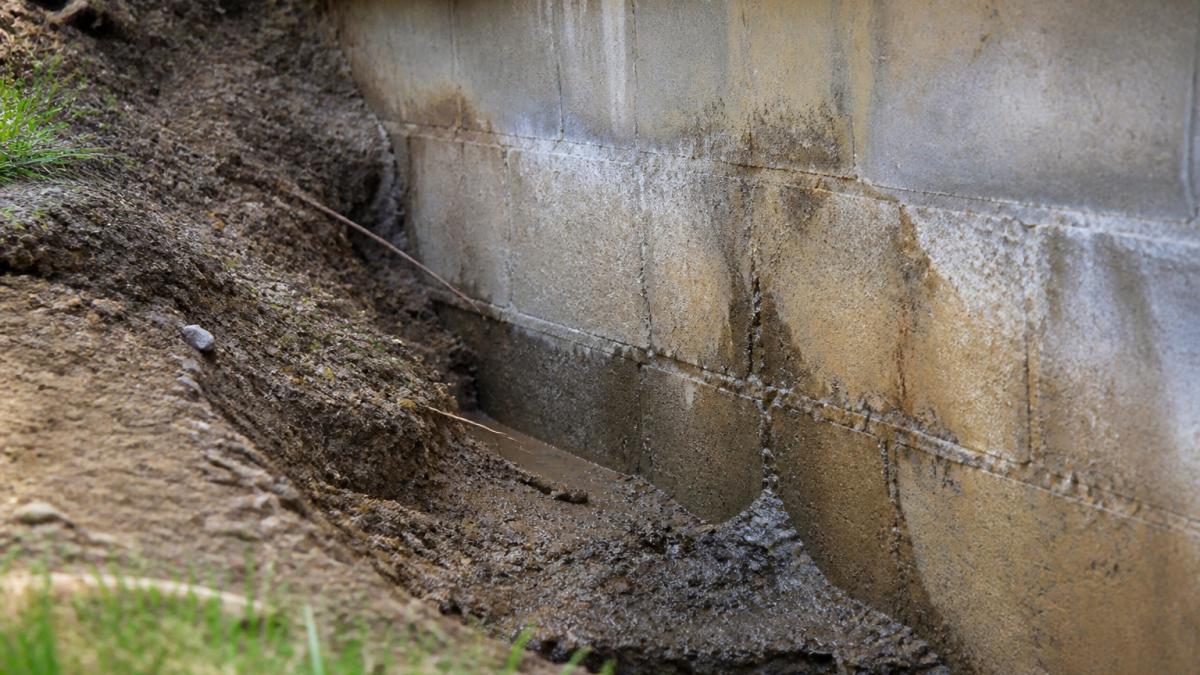
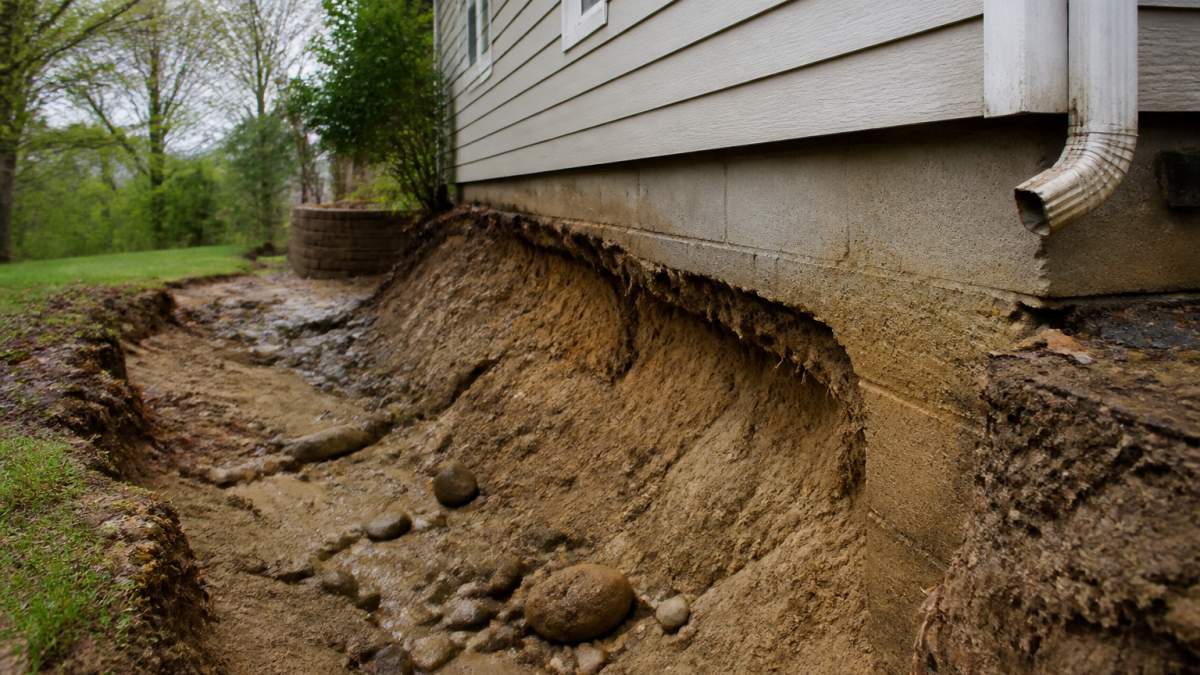
The damage happens gradually. Water runoff carries away topsoil and compacted earth, and your foundation loses the lateral support of stable soil pressing against it from outside.
Why soil erosion is bad for your foundation is straightforward: it removes the natural support system your home relies on, and without proper grading and drainage, water keeps eroding soil with every heavy rain.
The deeper issue: once erosion starts, it accelerates.
Signs of Foundation Damage from Erosion
Foundation damage from erosion shows itself in specific ways. Watch for these warning signs on your property.
Visible cracks in foundation walls are the most obvious indicator.
Gaps between your foundation and the soil mean erosion has already occurred.
Standing water near your foundation signals poor drainage.
Doors and windows that stick or won't close often result from foundation settling caused by soil erosion.
Mold or moisture in your basement frequently accompanies soil erosion.
Check your foundation regularly, especially after heavy rain. Does the soil slope away from the foundation? Is exposed foundation showing?
Grading Around House Foundation to Stop Erosion
Proper grading is your first defense against soil erosion, shaping the land so water flows away from your foundation instead of toward it.
Start by removing any soil that slopes toward your foundation, grade around house foundation areas often have compacted soil that directs water inward.
Add topsoil in layers, compacting each with a plate compactor before adding the next.
Plant vegetation on the graded slope.
Avoid planting trees too close to your foundation, roots can damage it.
Check your grading after heavy rains for areas where water collects or soil has washed away, and adjust the slope as needed.
How to Prevent Soil Erosion Around a House
Prevention is far more cost-effective than repairs. Start with these core strategies.
Install landscape fabric or a moisture barrier under mulch and ground cover.
Create swales or shallow drainage channels that direct water away from your foundation.
Use crushed stone or gravel as a base layer under landscape fabric. This aggregate improves drainage, provides a stable sub-base, and resists erosion.
Build retaining walls on slopes or grade changes.
Inspect after heavy rains. Walk your property after storms. Look for erosion, water pooling, or soil displacement. Catch small problems before they become big ones.
Drainage Solutions for Foundation Erosion
When grading alone isn't enough, drainage solutions become necessary. But the right system depends heavily on your soil type, your water table, and how much rain your region gets. A French drain that works beautifully in sandy loam can clog and fail in expansive clay. This section walks through each system and, more importantly, tells you which soil and climate conditions each one actually suits.
Match the System to Your Soil
Sandy soil drains fast but erodes easily. Water moves through it quickly, so surface grading often handles most runoff.
Clay soil is the opposite problem. It absorbs almost nothing, so water sheets across the surface and pools.
Silt and loam sit in between. They hold some water but drain reasonably. These soils respond well to a combination of grading, a shallow French drain, and vegetation.
Rocky or gravelly soil drains so fast that pooling is rare, but runoff velocity is high, so erosion at the surface is the real risk.
The Systems, and When Each One Fits
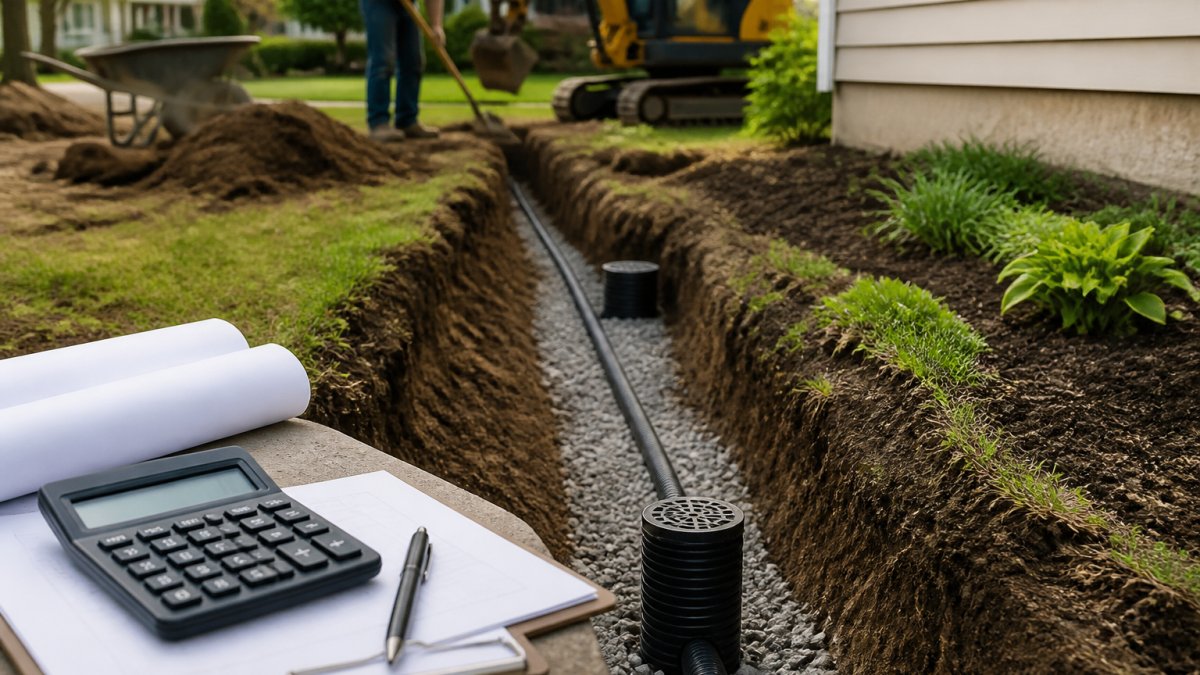
French drains are trenches filled with gravel around a perforated pipe that collects and redirects groundwater.
Exterior drain tile runs along the foundation footing, below the level where water would enter a basement.
Sump pumps handle water that collects in a pit, usually inside a basement or crawl space.
Swales are shallow, vegetated channels that carry surface water away.
Permeable paving, porous concrete, permeable pavers, or gravel, lets water infiltrate instead of running off.
Rain gardens are shallow planted depressions that capture and filter runoff.
Climate Adjustments Most Guides Skip
Drainage design changes with your climate, and this is where generic advice falls short.
In cold-winter regions, the frost line, the depth to which the ground freezes, determines how deep footings and drain tile must sit.
In heavy-rainfall regions, especially along the Gulf and Southeast coasts, the priority shifts to moving large volumes of water fast.
In drought-prone regions, the opposite risk appears: soil shrinks as it dries, pulling away from the foundation and opening gaps that let water pour in during the rare storm.
A Simple Decision Framework
Ask three questions in order:
- Where does the water come from? Roof runoff (gutters and downspouts), surface runoff (grading and swales), or groundwater (drain tile, French drains, sump pumps). Fix the cheapest source first, downspout extensions and grading cost far less than subsurface systems.
- What is my soil? Sandy or loamy soil tolerates infiltration features. Clay and high-water-table sites need collection-and-discharge systems, not infiltration.
- What is my climate? Cold regions need depth below frost and snowmelt capacity. Wet regions need volume capacity. Dry regions need shrink-swell management.
Answer those three and the right system usually picks itself. If you're unsure, a professional assessment that includes a percolation test and a look at your local frost depth will save you from installing the wrong system twice.
Water Runoff and Soil Compaction: The Foundation Connection
Water runoff and soil compaction work together to either protect or damage your foundation. But the relationship is more specific than "compact good, loose bad." The right compaction level, and the right way to achieve it, depends on your soil type and your climate, and getting it wrong can cause as much damage as doing nothing.
What Compaction Actually Does
Compaction removes air voids between soil particles and forces them closer together. Fewer voids mean less space for water to enter and less room for particles to shift. A well-compacted subgrade under a foundation spreads the load of the structure across a wider area instead of letting it concentrate under the footings.
The standard measure is relative compaction, expressed as a percentage of the maximum dry density a soil can achieve in a laboratory test (the Proctor test). Most residential foundation subgrades are specified at 95% or higher relative compaction.
Why Soil Type Changes Everything
Granular soils, sand and gravel, compact predictably. Vibration is the right tool, and moisture content matters: too dry and the particles won't lock together, too wet and the soil pumps and stays soft.
Fine-grained soils, silt and clay, are harder. Clay particles are flat and plate-like, and they don't compact well by vibration alone. They need kneading or sheepsfoot-type compaction and careful moisture control.
Expansive clay is the worst case. It swells when wet and shrinks when dry, and that cycle moves foundations regardless of how well the soil was compacted. In expansive clay, the goal isn't just compaction, it's moisture stabilization.
How Runoff Speed Drives Erosion
Water velocity is the single biggest factor in how much soil it carries. Doubling the speed of flowing water roughly quadruples its erosive energy, the relationship is not linear. That's why a steep, bare slope erodes catastrophically in one storm while a gently sloped, vegetated yard barely loses any soil.
Three things slow runoff:
- Slope. A gentler grade reduces velocity. This is why the recommended foundation slope is about 1 inch of drop per foot of horizontal distance, enough to move water, not enough to scour.
- Vegetation. Grass, ground cover, and shrubs intercept raindrops, slow sheet flow, and bind soil particles with roots. A dense lawn can reduce erosion dramatically compared to bare earth.
- Surface roughness. Mulch, gravel, and erosion-control matting break up flow and give water time to infiltrate.
The Compaction-Drainage Interaction
Here's the part most guides miss: over-compaction can be as harmful as under-compaction. A heavily compacted clay layer can act almost like pavement, preventing water from infiltrating and forcing it to run off at high velocity, which then erodes the next, less-compacted area downslope. The goal is a stable subgrade under the foundation and a permeable, vegetated surface around it, not a uniformly sealed yard.
In practice, that means:
- Compact the subgrade under the foundation and any fill to the specified density, in lifts.
- Keep the finished grade around the foundation sloped away at roughly 1 inch per foot for the first 6 feet.
- Leave the surrounding yard surface permeable and planted so water infiltrates rather than racing across it.
- In clay and expansive soils, add drainage and moisture control rather than trying to compact your way out of the problem.
Frost and Freeze-Thaw
In cold regions, freeze-thaw cycles undo compaction seasonally. Water trapped in the soil expands when it freezes, loosening the soil and heaving it upward. Over years, this can lift and crack foundations, walks, and slabs. The defenses are the same ones that handle drainage: keep water away from the foundation, place footings below the local frost depth (your building code specifies this), and use free-draining backfill that won't hold water against the wall.
The Bottom Line
Compacted soil plus controlled drainage equals foundation stability. Loose soil plus poor drainage equals foundation problems. But the details, lift thickness, moisture content, soil type, frost depth, and the balance between compaction and permeability, are what separate a foundation that lasts decades from one that cracks in five years. If you're unsure whether your subgrade was compacted correctly, a geotechnical evaluation or a compaction test is far cheaper than foundation repair.
When to Call a Professional for Foundation Erosion
Some erosion problems you can address yourself. Others require professional expertise.
Call a professional if you see foundation cracks. Cracks indicate structural movement.
Professional help is needed for bowing or leaning walls. These are serious structural issues.
If standing water won't drain after grading improvements, you likely need a drainage system.
When erosion is severe or widespread, professional site preparation makes sense.
If you're uncertain about proper grading slope, get professional guidance.
For new construction or major landscaping, professional grading from the start prevents future erosion.
OCAS Residential offers professional, efficient, and reliable property solutions, specializing in comprehensive land leveling, precision grading for new construction, and complete site cleanup with debris hauling.
Frequently Asked Questions
How does soil erosion damage a foundation?
Soil erosion removes the protective layer of earth around your foundation, exposing concrete or wood to water infiltration and structural stress. As soil washes away, it creates voids beneath and beside the foundation, reducing support and allowing water to pool against the foundation wall. Over time, this leads to cracks, settling, and structural failure. The process accelerates during heavy rain when water runoff channels directly against the foundation perimeter.
What are the main signs of foundation damage from erosion?
Watch for visible cracks in foundation walls, especially horizontal or stair-step patterns. Gaps between the foundation and soil, standing water near the base, or water seeping into basements signal erosion damage. You may also notice doors or windows sticking, uneven floors, or bowing basement walls. Exposed aggregate or concrete at the foundation line indicates soil has eroded away. These signs suggest your foundation has already lost protective soil cover and needs immediate attention.
Can proper grading around my house foundation really prevent erosion?
Yes. Correct grading slopes soil away from the foundation at a minimum 5% grade (6 inches of drop per 10 feet of distance). This redirects surface water away from the foundation perimeter before it can pool or infiltrate. Combined with compacted soil and landscape fabric, grading creates a stable, well-draining zone that resists erosion. Without proper grading, even heavy clay soil will erode under repeated water exposure.
What is the best drainage solution to stop foundation erosion?
A multi-layer approach works best: install landscape fabric to prevent soil migration, add a compacted crushed stone or aggregate base layer, establish proper grading to direct water away, and consider French drains or perimeter drainage systems for persistently wet sites. In areas with poor natural drainage, a moisture barrier and sump system may be necessary. The right solution depends on your soil type, climate, and existing water problems, professional assessment ensures you choose the most effective option.