 listicle
Signs Your Driveway Gate Needs Replacement
Table of Contents
- Structural Damage and Sagging
- Rust, Corrosion, and Material Deterioration
- Hinge Wear and Post Footing Issues
- Automatic Gate Opener Troubleshooting and Sensor Failures
- Driveway Gate Repair vs. Replacement Cost
- Average Lifespan of Residential Driveway Gates
- Safety Compliance and When to Replace
- Frequently Asked Questions
Last Updated: September 24, 2026
Your driveway gate is more than just an entry point, it's a security feature, a curb appeal investment, and a structural component that bears constant stress from weather, use, and time. But knowing when your driveway gate needs replacement versus repair can save thousands in unnecessary work. We help homeowners understand the critical warning signs that signal it's time to replace rather than patch.
Structural Damage and Sagging
The most obvious sign your driveway gate needs replacement is visible structural failure. Sagging typically happens at the hinge side first as the weight pulls downward and hinges or frame welds fail. You'll notice gaps at the top or bottom, and the latch won't catch properly.
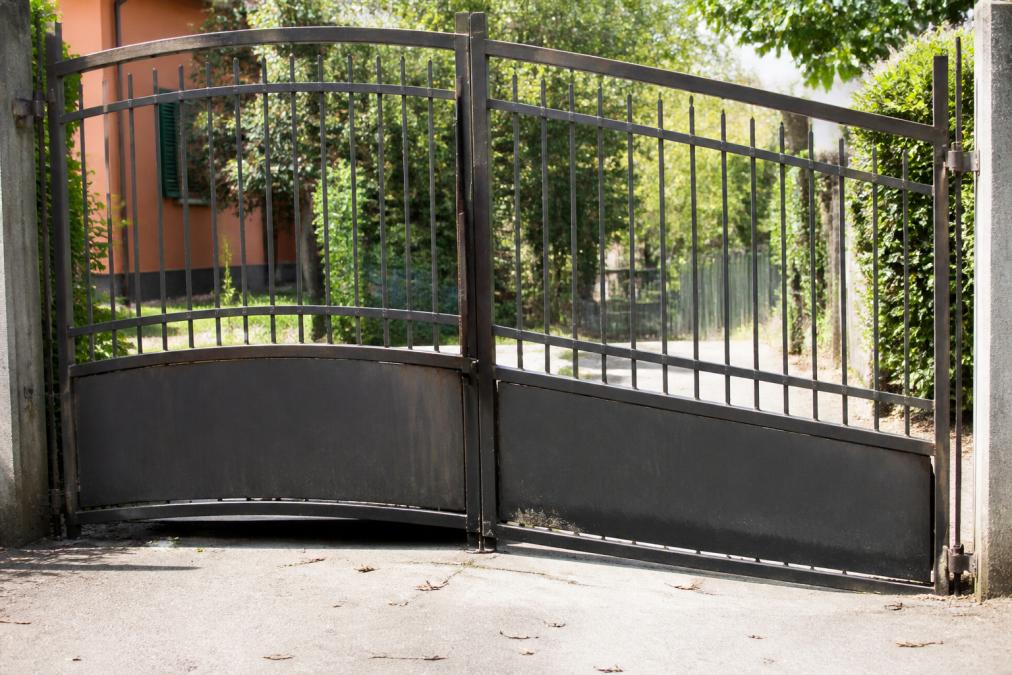
Bowing, where the gate panel curves outward or inward, usually means the frame is warping from extreme heat cycles or internal rust. Once bowing starts, it accelerates.
A gate sagging or bowing more than half an inch is beyond repair. Welding or hinge replacement only delays failure; the gate will continue to deteriorate.
Shifting posts worsen the problem. Uneven concrete settlement torques the frame with each cycle, accelerating hinge wear and frame failure. If posts are leaning, that's another sign your driveway gate needs replacement, the whole system is out of alignment.
Rust, Corrosion, and Material Deterioration
Gate failure looks different depending on material. Knowing what to look for, and what it means, helps you distinguish between cosmetic wear and structural failure.
Metal Gates: Rust and Corrosion Progression
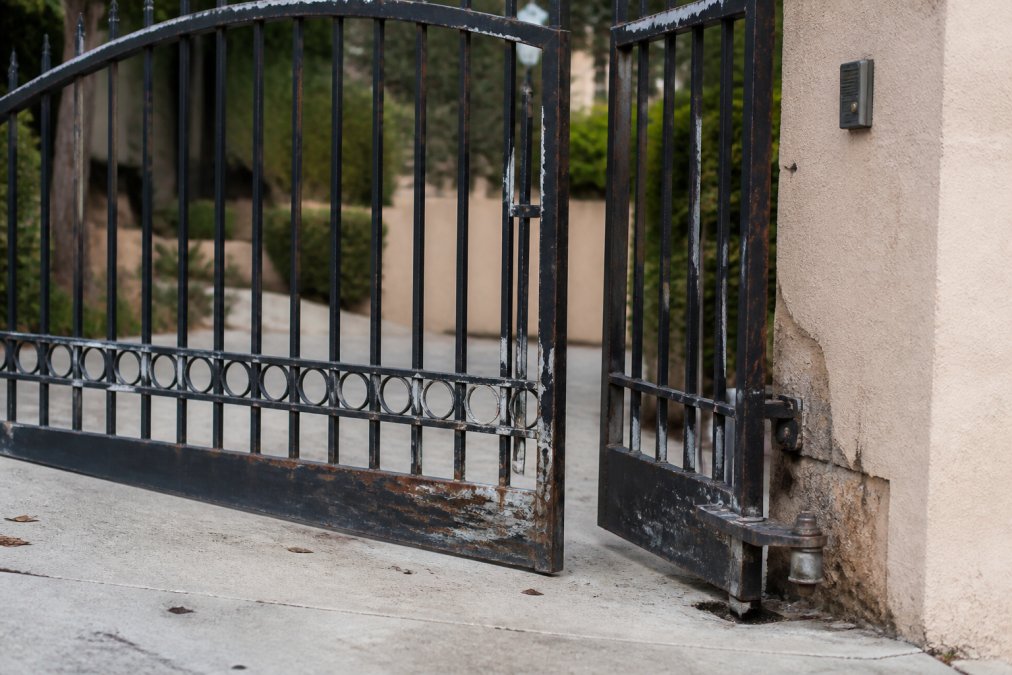
Metal gates corrode from the inside out. Surface rust is a warning sign; once it penetrates the protective coating, corrosion accelerates exponentially.
Early-stage corrosion (repairable): Light surface rust, rust staining around welds with no visible pitting, solid sound when tapped.
Mid-stage corrosion (questionable): Deep pitting (deeper than 1/32 inch), rough flaking areas, rust at welds, hollow sound when tapped.
Advanced corrosion (replacement necessary): Pitting deeper than 1/16 inch, metal crumbles when struck, visible holes, active rust bloom.
A well-maintained powder coat protects metal for 15-20 years; painted gates last 10-15 years; bare or failed-coating gates corrode critically in 5-8 years. Once pitting exceeds 1/16 inch, repainting is temporary, corrosion continues beneath the new coat.
Wood Gates: Rot and Structural Softening
Wood rot begins at ground level and spreads upward. Early-stage (repairable): soft wood less than 2 inches wide, slight screwdriver penetration. Mid-stage (risky): soft wood extends 6+ inches, screwdriver sinks 1/8-1/4 inch, visible cracking. Advanced (replacement required): screwdriver sinks more than 1/4 inch, visible mold, gate sags.
Wood gates last 10-15 years with regular sealing; unpainted gates rot within 5-8 years in humid climates. Once rot reaches hinges or frame joints, full replacement is the only reliable solution.
Vinyl Gates: Brittleness and Cracking
Vinyl becomes brittle in extreme heat and UV exposure; once cracked, it cannot be repaired. Early-stage (cosmetic): discoloration, scratches, flexible. Mid-stage (functional): visible cracks, reduced flexibility. Advanced (replacement necessary): multiple cracks, fragments when flexed, poor sealing.
Vinyl gates last 15-20 years in moderate climates, 10-15 years in intense heat, and degrade faster in coastal areas. Cracked vinyl cannot be sealed; replacement is the only permanent solution.
When to Inspect for Material-Specific Failure
Schedule a professional inspection if:
- Your metal gate is over 12 years old and shows any surface rust
- Your wood gate is over 8 years old and hasn't been sealed in the last 3 years
- Your vinyl gate is over 10 years old or shows visible cracks
- You notice any of the mid-stage indicators listed above
A professional can assess whether the material degradation is cosmetic or structural, and whether repair or replacement is the cost-effective choice.
Hinge Wear and Post Footing Issues
Hinges support the gate's weight and absorb stress from every cycle. Signs of wear: drooping, grinding sounds, increased force needed to open, visible gaps. If hinges show visible play, mounting holes may be stripped, and new hinges won't hold securely.
Post footing problems cause shifted posts, binding, sagging, and stress on hinges. Frost heave in cold climates causes repeated movement and footing cracks.
Automatic Gate Opener Troubleshooting and Sensor Failures
Automatic gate opener failures often coincide with structural gate failure. Sensor failures (most common) cost $200-400 to replace; motor wear costs several hundred dollars. If both the opener and gate structure are failing, replacing the entire system is often more cost-effective than repairing both separately.
Driveway Gate Repair vs. Replacement Cost
The decision between repair and replacement should be driven by clear financial calculation. The 50% rule is a starting point, but a rigorous cost-benefit analysis reveals the true tipping point for your gate.
The Repair Cost Tipping Point
Step 1: Calculate total replacement cost. Gather quotes for a new gate installed: basic swing gate $1,500-$3,000; sliding gate $2,500-$5,000; automatic swing gate $3,000-$6,000; automatic sliding gate $4,000-$8,000; premium gates $5,000-$15,000+. Get at least two quotes.
-
Will this repair address the root cause, or just the symptom?
- Replacing hinges on a sagging gate with shifted posts is a symptom fix. The posts are the root cause. You'll replace hinges again in 2-3 years.
- Resetting posts and replacing hinges together addresses both. This is a root-cause repair.
- If the repair only addresses symptoms, add 50% to the repair cost estimate to account for future repairs.
-
How much useful life remains?
- A 5-year-old gate with a broken motor: repair makes sense. You have 10-15 years of life left.
- A 18-year-old metal gate with rust and a broken motor: replacement makes sense. You're near the end of the gate's lifespan anyway.
- If the gate is over 75% through its expected lifespan, replacement is the better investment.
-
What's the risk of unexpected failure?
- A repaired gate might fail again in 6-12 months. Replacement comes with a warranty and predictability.
- If you can't afford a second repair soon, replacement eliminates that risk.
Real-World Cost-Benefit Scenarios
Scenario 1: 10-year-old metal gate, broken motor, hinges still good
- Replacement cost: $2,500
- Repair cost: $600 (motor replacement)
- Repair is 24% of replacement cost
- Decision: Repair. The gate is mid-life, the motor is the only failure, and you have 5-10 years of useful life remaining.
Scenario 2: 16-year-old metal gate, rust, sagging, broken motor
- Replacement cost: $2,500
- Repair cost: $1,800 (motor $600 + hinge replacement $400 + frame welding $400 + post reset $400)
- Repair is 72% of replacement cost
- Gate is near end of lifespan (metal gates last 15-20 years)
- Decision: Replace. Repair costs are high, the gate is aging, and you're stacking multiple repairs that address symptoms, not root causes. A new gate will last another 15-20 years.
Scenario 3: 8-year-old wood gate, rot at base, hinges worn
- Replacement cost: $2,200
- Repair cost: $1,400 (wood replacement $700 + hinge replacement $400 + resealing $300)
- Repair is 64% of replacement cost
- Wood gates last 10-15 years; this gate has 2-7 years left
- Decision: Replace. Rot spreads. You'll be back for more wood repairs in 2-3 years. Replacement is the better long-term investment.
Scenario 4: 6-year-old automatic gate, sensor failure, everything else works
- Replacement cost: $3,500
- Repair cost: $300 (sensor replacement)
- Repair is 9% of replacement cost
- Decision: Repair. The gate is young, the failure is isolated, and you have 9-14 years of life remaining.
The Warranty and Reliability Factor
A new gate comes with a manufacturer's warranty (typically 1-5 years) and a professional installation warranty. A repaired gate has no warranty. If the repair fails, you pay again.
When Professional Assessment Matters Most
If your repair estimate is between 40-60% of replacement cost, or if you're unsure whether repairs address root causes, get a professional assessment. A qualified gate technician can:
- Identify which repairs are temporary fixes versus permanent solutions
- Estimate how much useful life the gate has remaining
- Clarify whether the gate meets current safety codes (relevant for automatic gates)
- Provide a clear recommendation based on your specific situation
This assessment typically costs $75-$150 but saves you from making a costly mistake. A professional can often identify root causes you'd miss, turning a 72% repair scenario into a clear replacement decision, or confirming that a 24% repair scenario is the right choice.
Average Lifespan of Residential Driveway Gates
Understanding how long a gate should last helps you decide if replacement is overdue.
These timelines assume:
- Regular maintenance (lubrication, cleaning, inspection)
- A protective coating or finish that's maintained
- Proper drainage around posts to prevent water damage
- Hinges and hardware replaced as needed
Safety Compliance and When to Replace
Building codes and safety standards for automatic gates have evolved. Older gates may not meet current safety requirements.
Modern automatic gates must have:
- Obstacle detection sensors that stop the gate if something blocks it
- Manual override so the gate can be opened if power fails
- Warning signs indicating the gate is automatic
- Entrapment protection that prevents fingers or objects from being crushed
Frequently Asked Questions
How long should a residential driveway gate last?
Most residential driveway gates last between 15 to 20 years with proper maintenance. Automatic gates may require opener replacement sooner, typically every 10 to 15 years. Lifespan depends heavily on material (wood gates deteriorate faster than metal or vinyl), climate exposure, and how often the gate is used. Regular lubrication of hinges and protective coatings on metal gates can extend their life significantly.
Is it cheaper to repair or replace a driveway gate?
Small repairs like hinge replacement or sensor adjustment are usually cheaper than full replacement. However, once structural damage appears, sagging frames, extensive rust, or motor failure, replacement often becomes more cost-effective. If your gate is already 15+ years old and needs major work, replacement prevents repeated repair costs. Contact a professional for a site inspection to compare options.
What are the most common signs of a failing automatic gate opener?
Watch for slow opening or closing, gates that stop midway, remote control not responding consistently, or unusual grinding sounds from the motor. Sensor malfunctions cause gates to reverse unexpectedly or fail to close completely. If your gate opener is more than 10 years old and shows these signs, replacement is often more reliable than repair, since replacement gates typically include updated safety features and modern automation technology.
Can a rusted driveway gate be repaired?
Surface rust can be cleaned, treated, and coated to prevent further damage. Deep corrosion that weakens the metal structure, visible pitting, holes, or structural bowing, usually cannot be safely repaired and requires replacement. Have a professional inspect the extent of corrosion to determine if repair is viable or if replacement is necessary for safety and security.