 ultimate-guide
Land Leveling and Fence Installation Together: 2026 Guide
Table of Contents
- Why Grading and Fencing Work Better as One Project
- Cost and Timeline Benefits of a Single Contractor
- How to Fix Backyard Muddy Spots Before You Build
- Drainage Solutions for Residential Yards That Last
- Fence Installation on Sloped Terrain: Racking vs. Stepping
- Step-by-Step: Land Leveling and Fence Installation Together
- Step 1: Identify Utilities and Boundaries [Time: 1-2 hours]
- Step 2: Survey the Slope and Set Grade Stakes [Time: 2-3 hours]
- Step 3: Strip and Rough Grade [Time: 4-8 hours]
- Step 4: Compact and Fine Grade [Time: 2-4 hours]
- Step 5: Excavate Post Holes and Set Footings [Time: 4-6 hours]
- Step 6: Backfill, Install Panels, and Clean Up [Time: 4-6 hours]
- Common Mistakes That Undo Good Land Leveling
- When to Call a Professional for Grading and Fencing
- Frequently Asked Questions
Last Updated: September 15, 2026
Why Grading and Fencing Work Better as One Project
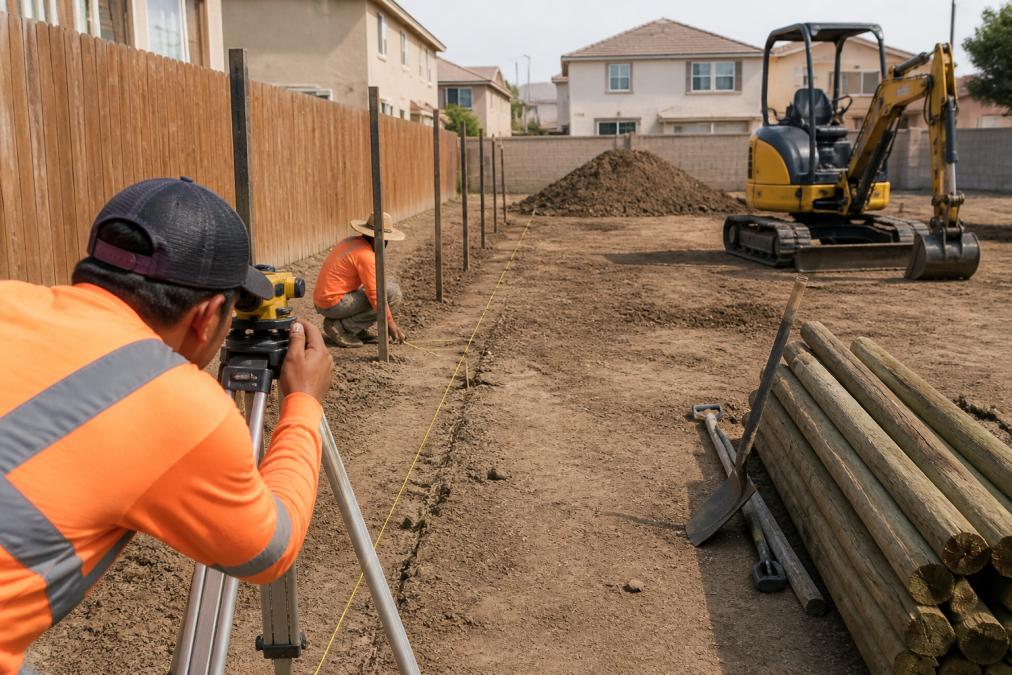
Land leveling and fence installation together is the most efficient way to prepare a residential lot, because grading equipment, survey stakes, and crew time are already on site. At OCAS Residential, we see homeowners schedule grading in spring and fencing in summer, then pay twice for mobilization and site prep. Combining both means one crew, one equipment pass, and one finished boundary line.
A fence post needs stable, compacted soil at a consistent depth. Grade after the fence goes in and you risk undermining footings or burying the bottom rail. Grade first, then set posts, and the system holds together.
Cost and Timeline Benefits of a Single Contractor
Hiring one contractor for both land leveling and fence installation can streamline the process and help avoid leaving a freshly graded lot exposed to rain.
The savings come from three places:
- Single mobilization of excavators, skid steers, and compaction equipment
- Shared surveying so the fence line and grade stakes are set in one pass
- One point of accountability if something shifts after the work is done
For a property owner in Davie or Weston, that coordination can be a significant factor. A two-vendor quote may incur additional costs once factors like a second trip, permits, and rework are considered.
How to Fix Backyard Muddy Spots Before You Build
Fixing backyard muddy spots starts with finding where water actually collects, not where it looks wet. Most standing water comes from a low spot with no outlet, compacted fill that won't drain, or a grade sloping back toward the house.
Walk the lot after a heavy rain and mark every puddle with a stake, that map tells you more than any soil test. Water pooling within 3 meters of the foundation is a priority fix; at the back fence line, you have more flexibility.
Reading Slope and Drainage Patterns on Your Lot
Reading slope means measuring how the ground falls across your property and where it sends water. A minimum 2% slope away from the foundation, about 2 centimeters of drop per meter of run, is the standard most builders work to (hud.gov).
Check three things:
- The direction water travels during a storm
- Whether neighboring lots drain onto yours
- Where the lowest point sits relative to your fence line
If your lot is flat or slopes toward the house, grading is not optional.
Drainage Solutions for Residential Yards That Last
Drainage solutions for residential yards fall into three categories: surface grading, subsurface drainage, and retention. The right mix depends on your soil, slope, and water volume.
Surface grading reshapes the ground so water flows to a designated low point or swale. It's the cheapest fix and the one most homeowners should start with. A swale, a shallow, vegetated channel typically 12 to 18 inches wide at the bottom, carries sheet flow to an outlet instead of letting it pond.
Subsurface drainage uses French drains or perforated pipe buried below grade to pull water away from problem areas, and works well where heavy clay soil won't absorb water quickly. The critical detail most guides skip: the pipe needs a continuous fall, about 1 inch of drop per 8 to 10 feet of run, or water sits in the pipe and the drain stops working.
Retention holds water on site in a shallow basin or rain garden so it soaks in gradually. It suits larger acreage and is often the only option when local rules limit off-site runoff.
Matching the Fix to Your Soil
Soil type drives the decision more than slope does. Sandy and loamy soils drain fast, so surface grading alone often solves the problem. Heavy clay, common across much of the South and Midwest, drains slowly enough that surface grading just moves the puddle, which is when a French drain or dry well earns its cost. Before you commit, dig a test hole about 2 feet deep, fill it with water, and see how long it takes to disappear.
Sizing and Placement
A few rules of thumb that hold up in practice:
- Route water at least 6 to 10 feet away from the foundation before it's allowed to spread.
- Keep the outlet of any drain above the seasonal high water table, or it will back up.
- Never daylight a drain onto a neighbor's lot, that's a fast route to a complaint and, in many jurisdictions, a code violation.
- Size the swale or pipe for the worst storm you expect in a 10-year window, not the average rain.
| Solution | Best For | Relative Cost | Maintenance |
|---|---|---|---|
| Surface grading / swale | Mild slope issues, sandy or loamy soil | Lowest | Low, occasional reshaping |
| French drain | Heavy clay soil, persistent wet spots | Moderate | Medium, flush and inspect annually |
| Dry well | Small, isolated low spots | Moderate | Medium, can silt up over time |
| Retention basin / rain garden | Large lots, runoff restrictions | Highest | Medium, plant and sediment management |
According to guidance from the USDA Natural Resources Conservation Service, managing surface runoff at the source prevents most residential erosion problems before they start.
Erosion Control at the Fence Line
A newly installed fence on a slope creates an obstruction at every post, and water running downhill finds the gaps and cuts channels around the footings. Two fixes work: a shallow gravel apron at the base of each post to disperse flow, and erosion-control blanket or riprap along the uphill side of the fence run. On steeper grades, a small berm or diversion swale a few feet uphill intercepts water before it reaches the posts. Do this at installation, not after the first washout.
Fence Installation on Sloped Terrain: Racking vs. Stepping
Fence installation on sloped terrain comes down to two techniques: racking panels or stepping them. Racking follows the slope smoothly; stepping creates level sections with vertical drops between them. This is also where land leveling and fence installation stop being separate decisions, how much you level determines how much racking or stepping the fence absorbs.
Racking Panels
Racking tilts each panel to follow the ground line, keeping the top and bottom rails parallel to the slope. It looks clean on gentle grades, but past a certain angle the pickets look slanted and the posts sit at awkward angles.
Most installers cap racking at around 15 degrees of slope, roughly a 1-foot rise over a 4-foot run. Racking also depends on panel design: vertical pickets with horizontal rails can rack; a rigid welded frame or pre-assembled diagonal bracing often can't.
Stepping Panels
Stepping keeps each panel level and drops the fence in stages down the hill, the standard approach on steep lots because every panel stays square and structurally sound. The trade-off is the visible stair-step silhouette. A 6-foot panel typically steps in 6- to 12-inch increments so the bottom rail stays above grade and the top rail stays level.
How Material Changes the Answer
- Wood is the most forgiving.
The Leveling Trade-Off
When Neither Method Works
Step-by-Step: Land Leveling and Fence Installation Together
Step 1: Identify Utilities and Boundaries [Time: 1-2 hours]
Step 2: Survey the Slope and Set Grade Stakes [Time: 2-3 hours]
Step 3: Strip and Rough Grade [Time: 4-8 hours]
Step 4: Compact and Fine Grade [Time: 2-4 hours]
Step 5: Excavate Post Holes and Set Footings [Time: 4-6 hours]
Step 6: Backfill, Install Panels, and Clean Up [Time: 4-6 hours]
Common Mistakes That Undo Good Land Leveling
Three more mistakes we see regularly:
When to Call a Professional for Grading and Fencing
A few clear signals:
Frequently Asked Questions
Should I grade my yard before installing a fence?
Yes. Grading first lets you set fence posts at the correct depth and height without working around existing panels. It also prevents water from pooling at the base of posts, which speeds up rot and rust. When land leveling and fence installation happen together, the crew can adjust slope, confirm drainage, and set posts in one pass instead of tearing out work later.
Can you install a fence on sloped or uneven ground?
Yes. Two methods handle slope: racking, where panels follow the incline in one continuous line, and stepping, where panels sit at fixed heights in stair-step sections. Racking suits gentle grades and looks cleaner on long runs. Stepping works better on steep drops and keeps fence height consistent. The right choice depends on your grade, fence material, and how the fence line aligns with property boundaries.
How much does it cost to level a yard before fencing?
Pricing depends on lot size, how much cut and fill the grade needs, soil conditions, and whether drainage fixes like French drains or a retaining wall are required. Small drainage corrections cost far less than full-lot regrading. OCAS Residential provides free estimates based on an on-site review, so you get a number tied to your actual property rather than a generic per-acre figure.
What is the benefit of hiring one contractor for grading and fencing?
One contractor means one schedule, one point of contact, and no finger-pointing if something goes wrong. Grading crews and fence crews coordinate post spacing, footing depth, and final grade so the fence sits at the right height and water drains away from it. Splitting the work between two companies often adds weeks and creates gaps where each blames the other for problems.