 how-to
How to Fix Backyard Muddy Spots: 7 Proven Steps
Table of Contents
- What's Actually Causing Your Backyard Muddy Spots
- What You'll Need Before You Start
- Yard Drainage Solutions That Actually Work
- How to Install a French Drain Step by Step
- Improving Soil Structure to Stop Backyard Muddy Spots
- Residential Land Grading Cost: DIY vs. Hiring a Pro
- Maintenance Schedule to Keep Mud From Coming Back
- Conclusion
Last Updated: August 25, 2026
What's Actually Causing Your Backyard Muddy Spots
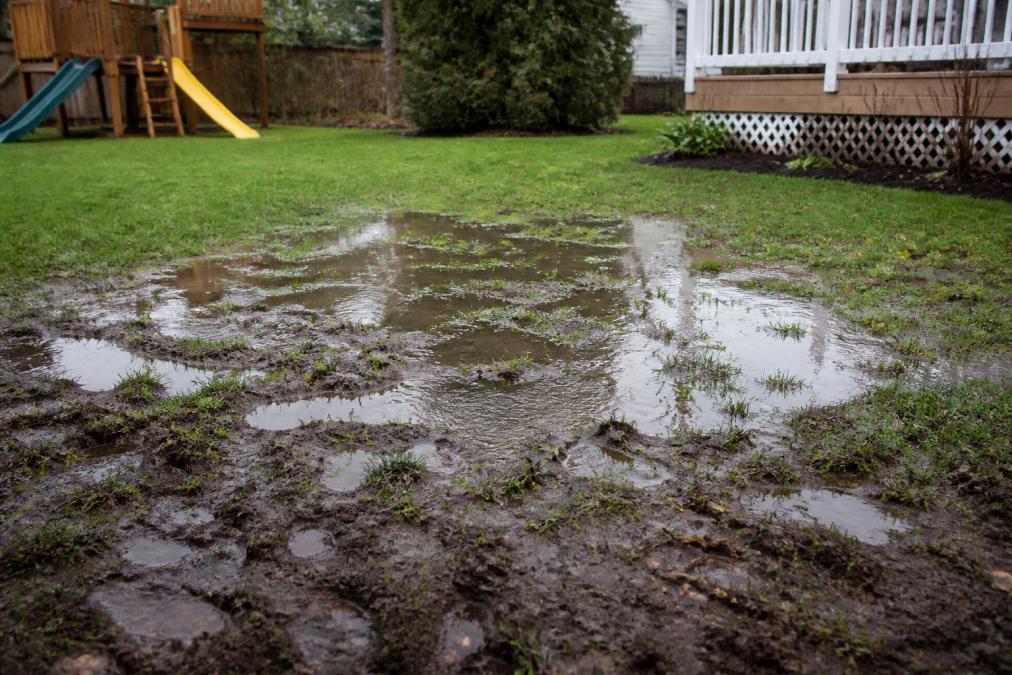
Backyard muddy spots are rarely a mystery once you know what to look for. Mud forms when water has nowhere to go, the fix depends entirely on what's creating the problem, and choosing the wrong solution wastes both time and money.
Clay Soil and Compaction
Clay soil is dense, hydrophilic soil that absorbs water slowly and compacts easily under foot traffic, vehicle weight, or heavy rainfall. Once compacted, clay loses the pore space needed for water to move downward, turning your yard into a shallow pond after every rain.
Soil compaction is the single most common cause of persistent backyard muddy spots. A simple test: push a screwdriver into wet soil. If it takes real effort to push 6 inches down, compaction is a significant factor.
Poor Grading and Surface Runoff
Most residential lots are graded to slope away from the foundation, but grading settles over years. Low spots develop, surface water pools, and runoff concentrates in the same location repeatedly. Poor topography is often invisible until you walk the yard after heavy rain and trace where water flows.
Gutter Downspouts and Concentrated Water Flow
A downspout discharging directly onto a lawn can saturate a 10-square-foot area within minutes during a moderate storm. Check where each downspout terminates. If water is pooling within 5 feet of the discharge point, a downspout extension or underground drainage connection is the most direct fix.
What You'll Need Before You Start
Before addressing backyard muddy spots, walk the yard during or immediately after rain. Note where water enters, where it pools, and how long it takes to drain. This reconnaissance determines which solution applies.
Depending on the fix you choose, you'll likely need:
- Perforated drain pipe and filter fabric for French drain installation
- Crushed gravel or river rock for drainage trenches and dry wells
- Organic compost, gypsum, or pine bark for soil amendment
- A core aerator (available at most equipment rental centers)
- Downspout extensions or pop-up emitters
- A slope level or line level to verify grading
For larger grading corrections or subsurface drainage systems, professional equipment is typically required.
Yard Drainage Solutions That Actually Work
Effective yard drainage solutions match the fix to the failure.
Dry Wells and Catch Basins
A dry well is an underground chamber filled with gravel that collects surface water and allows it to percolate slowly into surrounding soil. A catch basin is a surface-level inlet that captures runoff and channels it into an underground pipe system.
Dry wells work best in areas with reasonable native soil permeability beneath the compacted surface layer. They're practical for isolated muddy spots near downspouts or low points where a French drain would be difficult to route. Most residential dry wells are installed 3 to 4 feet deep.
Catch basins are better suited to areas with heavy surface runoff, such as the base of a slope or a low point between elevated sections.
Rain Gardens and Swales
A swale is a shallow, gently sloped channel designed to slow and redirect surface water across a landscape. A rain garden is a planted depression that captures runoff and allows it to infiltrate over 24 to 48 hours through deep-rooted, water-tolerant plants.
Both work with your site's natural topography rather than fighting it. According to EPA's guidance on green infrastructure and stormwater management, rain gardens can reduce runoff from a drainage area significantly while improving groundwater recharge.
Swales are particularly effective for redirecting water from one area to another. They require proper grading to function correctly, and the slope must be consistent to prevent pooling.
Permeable Pavers as a Hardscaping Fix
Permeable pavers allow water to pass through the surface into a gravel sub-base and then into the soil below, eliminating surface runoff entirely in high-traffic zones. This approach works especially well for paths, patios, and areas near gates or doors where foot traffic compacts soil repeatedly.
The upfront cost is higher than basic drainage fixes, but permeable pavers eliminate the mud problem permanently without requiring ongoing maintenance. As documented in University of Minnesota Extension resources on permeable pavement, permeable surfaces significantly reduce stormwater runoff volume compared to conventional hardscaping.
How to Install a French Drain Step by Step
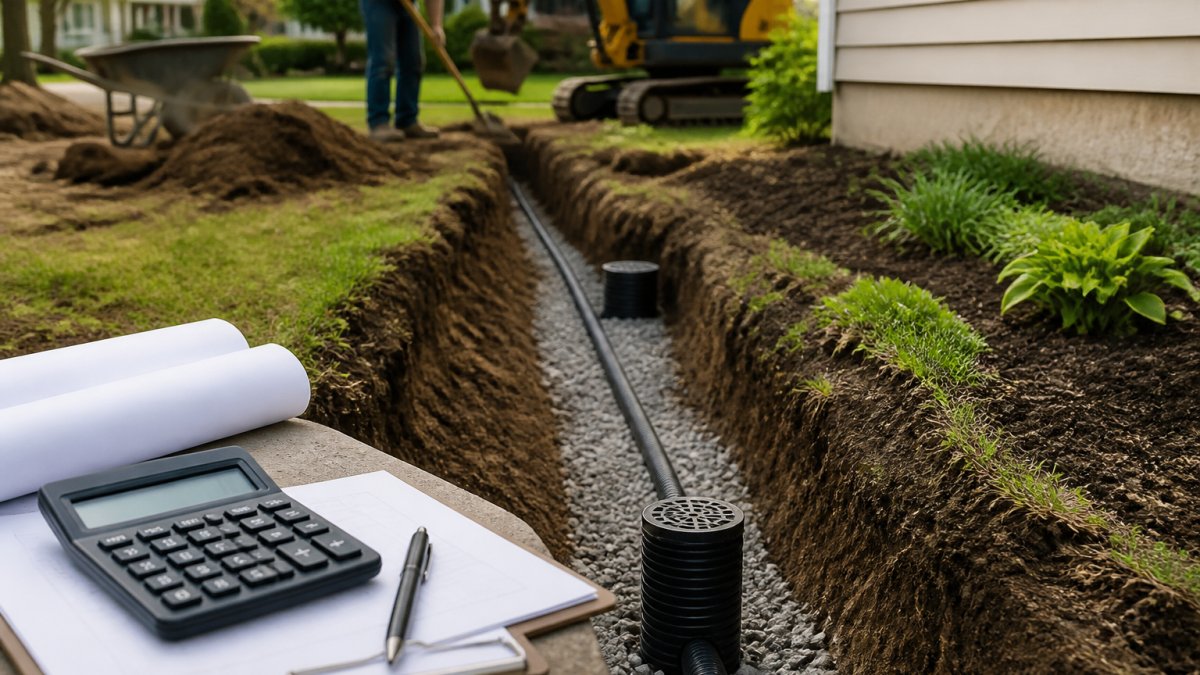
A French drain is a perforated pipe buried in a gravel-filled trench that intercepts subsurface water and redirects it away from problem areas. It's one of the most reliable solutions for chronic muddy spots caused by high water tables or subsurface water migration.
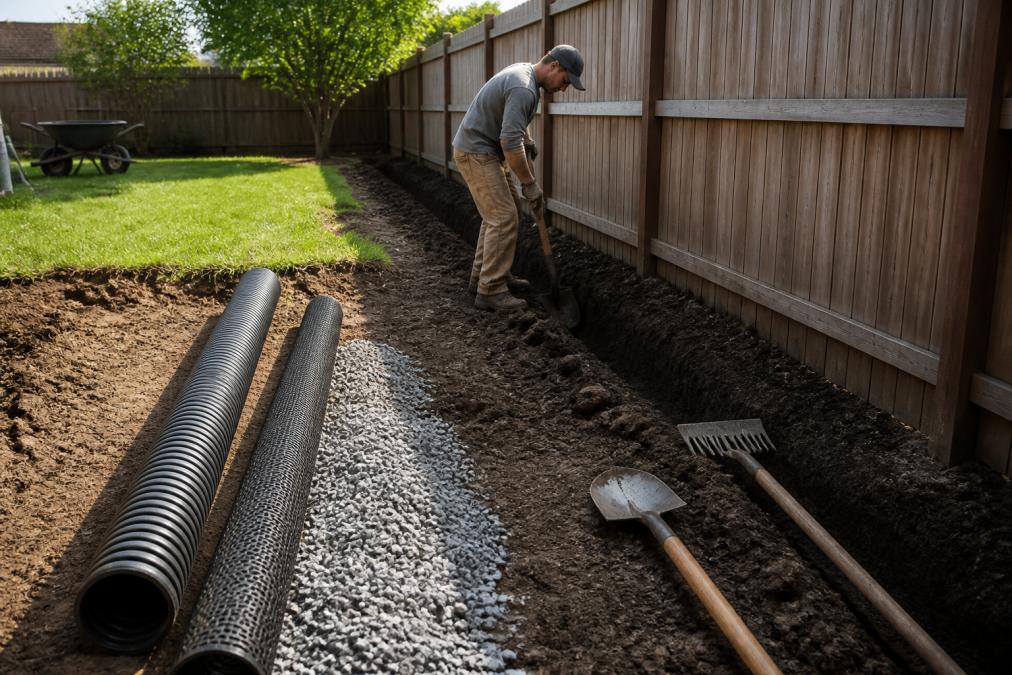
Total Time: 4 to 8 hours for a standard residential installation Difficulty: Moderate to Advanced (heavy digging required)
What You'll Need:
- Perforated drain pipe (4-inch diameter is standard for residential use)
- Landscape filter fabric
- Crushed gravel (3/4-inch clean stone)
- Shovel, trenching spade, or mechanical trencher
- Line level or laser level
Step 1: Mark the Drain Path [Time: 30 minutes] Identify the entry point (where water collects) and the exit point (where water will discharge). The trench must slope consistently downward at a minimum of 1 inch of drop per 8 feet of run. Mark the path with spray paint or stakes.
Step 2: Dig the Trench [Time: 2 to 4 hours] Dig the trench 12 to 18 inches deep and 6 to 12 inches wide. Maintain consistent slope throughout.
Step 3: Line the Trench with Filter Fabric [Time: 20 minutes] Lay filter fabric along the bottom and sides of the trench, leaving excess to fold over the top of the gravel later. This prevents soil migration into the gravel bed.
Step 4: Add Gravel and Place the Pipe [Time: 30 minutes] Pour 2 to 3 inches of crushed gravel into the trench. Place the perforated pipe on top with the holes facing down. Cover the pipe with additional gravel to within 3 to 4 inches of the surface.
Step 5: Wrap and Backfill [Time: 20 minutes] Fold the filter fabric over the top of the gravel. Backfill the remaining trench with soil and seed or sod as needed.
Expected Result: Water that previously pooled at the surface will now be intercepted below grade and routed away from the problem area.
Improving Soil Structure to Stop Backyard Muddy Spots
Drainage fixes address where water goes. Soil structure determines whether the ground itself can handle normal rainfall without turning to mud.
Lawn Aeration and Overseeding
Lawn aeration mechanically removes small plugs of soil across the lawn surface to reduce compaction and improve water infiltration. Core aeration is the most effective method for residential lawns and should be performed annually on lawns with heavy clay content or significant foot traffic.
After aeration, open channels allow water, air, and nutrients to reach deeper soil layers. Overseeding immediately after aeration fills thin areas with grass that develops deep root systems, further improving moisture retention and erosion control. Aerate in the growing season for your grass type so the lawn recovers quickly.
Organic Compost, Gypsum, and Ground Cover
Three amendments address clay soil and compaction:
- Organic compost improves soil structure by adding organic matter that separates clay particles, creating pore space for water movement. Apply 2 to 3 inches across the affected area and work it into the top 6 inches of soil.
- Gypsum (calcium sulfate) improves clay soil drainage without significantly changing soil pH by encouraging clay particles to clump into larger aggregates, creating better drainage pathways.
- Pine bark and other coarse organic ground covers protect bare soil from raindrop impact, a primary driver of surface compaction and erosion.
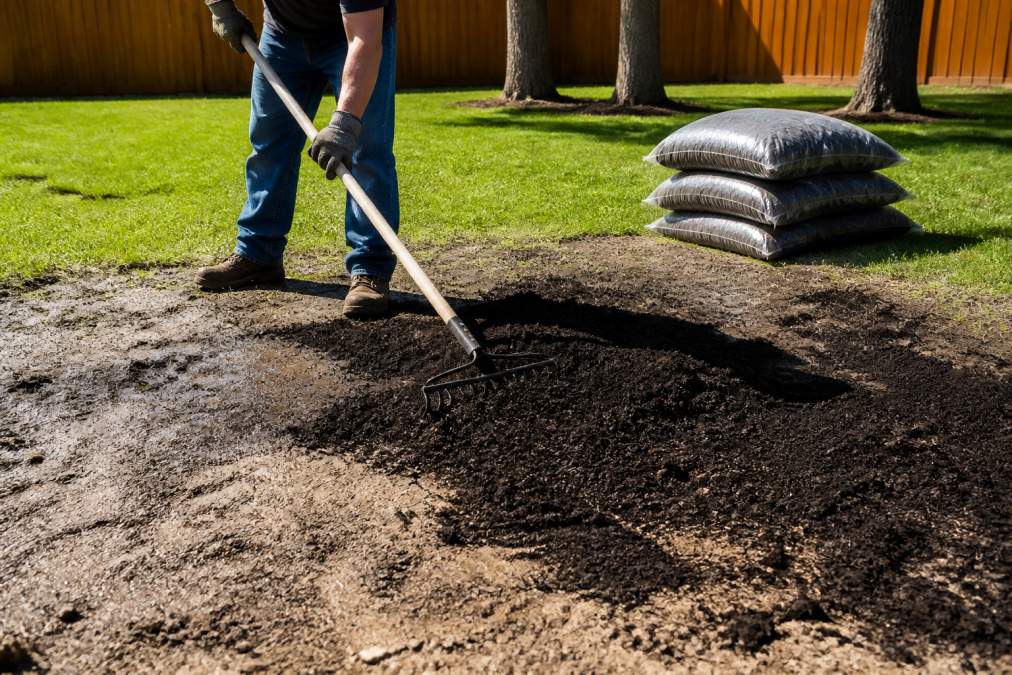
According to USDA Natural Resources Conservation Service guidance on soil health, adding organic matter is one of the most consistently effective long-term strategies for improving drainage in compacted and clay-heavy soils.
Residential Land Grading Cost: DIY vs. Hiring a Pro
The decision between DIY and professional grading comes down to scale, equipment access, and the consequence of getting it wrong.
Factor | DIY Approach | Professional Grading |
|---|---|---|
Equipment needed | Shovels, rakes, wheelbarrow | Skid steer, laser level, compactor |
Best for | Small isolated spots under 200 sq ft | Whole-yard slope corrections |
Accuracy | Difficult to verify without tools | Laser-verified consistent slope |
Risk if wrong | New low spots, wasted material | Professional liability, corrected work |
Time required | Full weekend or more | Typically 1 to 2 days |
Ongoing maintenance | High (settles unevenly) | Low (properly compacted base) |
DIY grading makes sense for small, isolated backyard muddy spots where the fix involves adding topsoil to a low point. For anything involving whole-yard slope corrections, drainage toward the foundation, or sod preparation, professional grading produces significantly better results.
The real cost of DIY grading done incorrectly is often higher than the professional alternative. Poorly graded yards can direct water toward foundations and require complete rework within a season or two.
OCAS Residential specializes in precision land grading and effective drainage solutions for residential properties. For homeowners dealing with persistent backyard muddy spots that haven't responded to surface-level fixes, professional site assessment is the fastest path to a lasting result. Contact OCAS Residential to schedule a free estimate.
Maintenance Schedule to Keep Mud From Coming Back
Fixing backyard muddy spots once is only half the job. Without a maintenance routine, compaction returns and the same corners turn muddy again within a few seasons.
Every Spring:
- Clear debris from catch basin inlets and dry well access points
- Inspect French drain outlets to confirm water is discharging freely
- Check downspout extensions for disconnections or blockages
- Walk the yard after the first heavy rain and note any new low spots
Every Fall:
- Core aerate lawns with clay soil or heavy traffic
- Apply compost top-dressing to thin or bare areas before overseeding
- Clean gutters and verify downspouts are properly extended away from the house
Every 3 to 5 Years:
- Flush French drain systems with a garden hose to check for sediment buildup
- Reassess yard grading, particularly near the foundation and fence lines
- Consider reapplying gypsum to clay-heavy areas showing renewed compaction
Subsurface drainage systems have long service lives when properly maintained. The Penn State Extension guidance on lawn drainage and maintenance recommends annual aeration as a baseline practice for any lawn with clay soil, noting that consistent aeration prevents the compaction cycle from reestablishing after initial remediation.
Persistent backyard muddy spots are a solvable problem, but the solution must match the cause. Soil compaction, poor grading, and concentrated water flow each require a different approach, and layering the right fixes together produces lasting results.
OCAS Residential provides professional land leveling, precision grading, and complete drainage solutions for residential properties. Whether the problem is a single muddy corner or a yard-wide drainage failure, our team delivers proper landscape preparation and effective site correction. Schedule your free estimate with OCAS Residential and get a clear plan for fixing the problem permanently.
Frequently Asked Questions
What is the cheapest way to fix a muddy yard?
The lowest-cost starting point is improving soil structure. Aerating compacted ground, top-dressing with organic compost, and adding pine bark mulch to the worst spots can reduce mud significantly without heavy equipment. Extending gutter downspouts away from the problem area is another low-cost fix. For persistent standing water caused by grading issues or clay soil, a French drain or professional re-grading will cost more upfront but prevents ongoing damage to your lawn and foundation.
Why is my yard always wet and muddy?
Chronic mud usually points to one of three root causes: clay soil that holds water instead of draining it, poor grading that channels surface runoff toward a low spot, or a drainage system that's undersized or blocked. Gutter downspouts discharging near the house are a frequent culprit. Identifying which cause applies to your backyard muddy spots determines the right fix — soil amendments alone won't solve a grading problem, and re-grading won't fix hydrophilic clay without also amending the soil.
When should I hire a professional for yard grading?
Hire a professional when standing water sits for more than 24 to 48 hours after rain, when the slope directs water toward your foundation, or when the affected area is larger than roughly 100 square feet. DIY grading with rented equipment can work for minor low spots, but improper grading can worsen drainage and create erosion. A professional land grading service has the equipment and expertise to assess topography, set correct slopes, and tie the grading into an existing drainage system.
Can a rain garden help fix standing water in my backyard?
Yes. A rain garden is a shallow, planted depression designed to collect surface water and allow it to absorb into the ground over 24 to 48 hours. It works best when the underlying soil has reasonable permeability — not pure clay. In clay-heavy yards, amending the rain garden's base with compost and coarse sand improves infiltration. Rain gardens also control erosion and add landscaping value. They pair well with swales or downspout extensions that direct runoff into the garden rather than across the lawn.