 listicle
Best Fence Installation for Residential Security in 2026
Table of Contents
- Why Residential Security Fencing Is a Smart Investment
- Best Residential Security Fence Materials Compared
- Average Cost of Security Fence Installation
- How to Reinforce a Fence for Security
- Fence Site Preparation and Grading: The Critical First Step
- Top Fence Installation Services for Security
- DIY vs. Professional Installation Risks
- Conclusion: Securing Your Property Perimeter
- Frequently Asked Questions
Last Updated: September 4, 2026
Why Residential Security Fencing Is a Smart Investment
Your perimeter is the first line of defense for your home, and a properly engineered residential security fence deters trespassers, defines access points, and gives you control over who enters your property. This guide from OCAS Residential compares materials, reinforcement strategies, and installation approaches.
A fence with anti-climb features, secure gate hardware, and proper foundation depth reduces opportunistic crime by making entry difficult and time-consuming. Beyond deterrence, a quality fence adds curb appeal, contains children and pets, and supports smart security integration.
Below, we'll show you how to evaluate materials, what reinforcement features matter, and why site preparation determines whether your fence survives its first storm season.
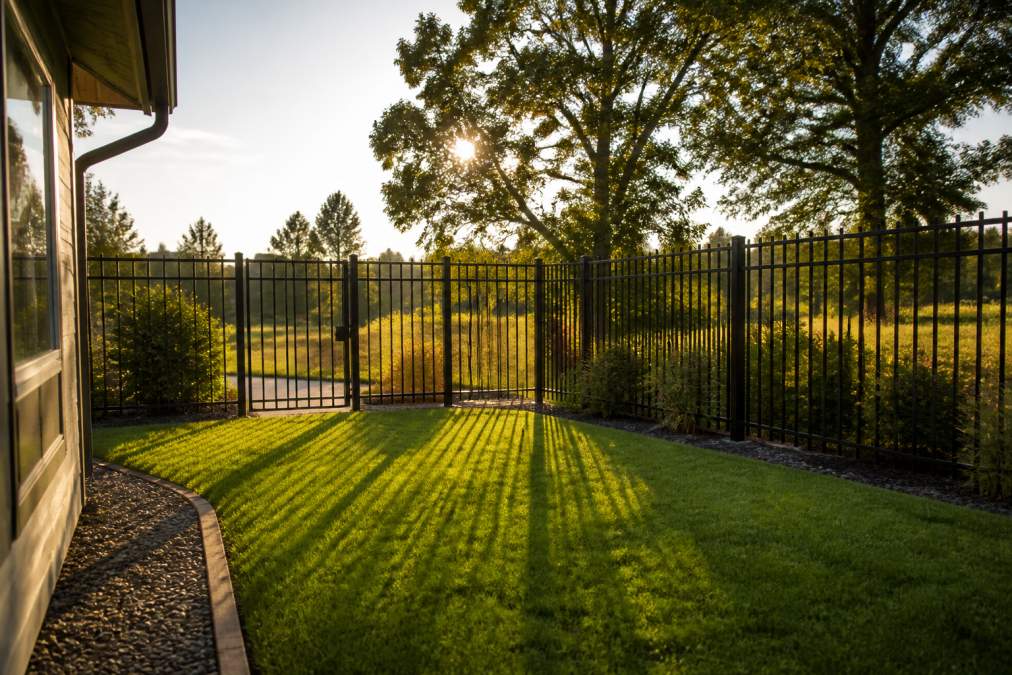
Best Residential Security Fence Materials Compared
The best material choice depends on your priorities: maximum deterrence, visibility, privacy, or a balance of all three. Each material offers different trade-offs in structural integrity, maintenance, and service life.
| Material | Security Level | Visibility | Maintenance | Best Use Case |
|---|---|---|---|---|
| Ornamental Steel / Wrought Iron | High | Full visibility | Low-moderate | Maximum deterrence with curb appeal |
| Chain-Link / Welded Wire | Moderate | Full visibility | Low | Containment with clear sightlines |
| Vinyl | Moderate | Opaque | Very low | Privacy with minimal upkeep |
| Wood | Low-moderate | Opaque | High | Privacy on a budget |
| Composite | Moderate-high | Opaque | Very low | Long-term durability with privacy |
Steel and Wrought Iron: Maximum Deterrence
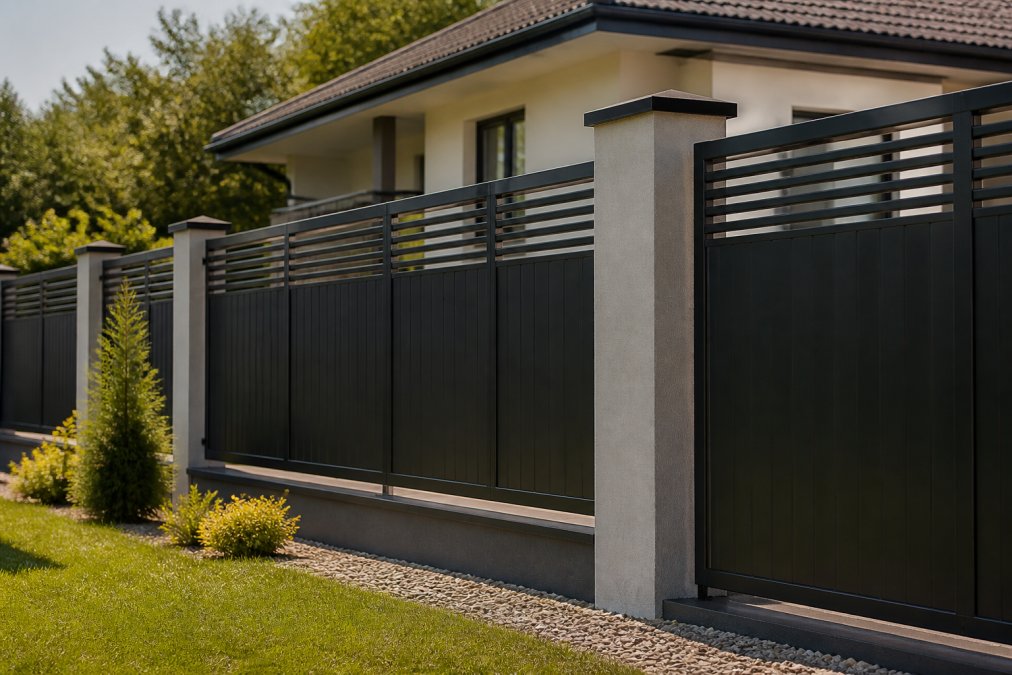
Ornamental steel and wrought iron are the gold standard for residential security. The vertical bars resist climbing, and the material is difficult to cut or breach without significant noise and time. Horizontal rails create a ladder effect, so look for designs with minimal horizontal elements or add climb-resistant features.
The main drawback is cost, but the service life is measured in decades with proper corrosion resistance treatment.
Chain-Link and Welded Wire: Visibility and Containment
Chain-link and welded wire provide a clear deterrent while maintaining full visibility, which is valuable for monitoring activity around your property line. Welded wire with tight mesh spacing offers better climb resistance than standard chain-link.
These materials excel at containment for large properties where cost per linear foot matters. The trade-off is aesthetic: chain-link lacks curb appeal and offers zero privacy, so pair it with dense shrubs to soften the look.
Vinyl, Wood, and Composite: Privacy with Reinforcement
Privacy fences block sightlines, meaning intruders cannot case your property, but they also block your view. A solid vinyl or composite fence provides a clean appearance with minimal maintenance; wood requires regular staining or painting to maintain structural integrity against moisture and rot.
The security weakness of privacy fences is their climbability: solid panels provide footholds, and the lack of visibility means a trespasser can work undisturbed. Reinforcement is essential, add anti-climb caps, eliminate exterior horizontal rails, and ensure picket spacing is tight enough to prevent footholds.
Average Cost of Security Fence Installation
Pricing varies widely based on material, linear footage, gate hardware, and site conditions. For current pricing, please schedule a free estimate with OCAS Residential.
The Real Cost Drivers
Linear footage and economies of scale. The per-foot price drops as the project grows because mobilization costs are spread across more footage.
Gate hardware is disproportionately expensive. A basic walk gate adds to the cost; a double-drive gate with automated openers and access control can add significantly more.
Site conditions. Rocky soil requires specialized augers or hand-digging, adding to the cost per post. Sloped lots require stepped panels or custom fabrication, adding to material cost. Poor drainage requiring grading work adds to the overall project cost.
Post installation is non-negotiable. The post hole should be at least one-third of the post height above ground, and for security fences, many contractors recommend 40% of total post length. Each post set in concrete adds to the material cost alone.
Where You Can Save Without Sacrificing Security
Choose welded wire over chain-link. For the same security level, welded wire with tight mesh spacing costs only slightly more but offers better climb resistance and a cleaner appearance.
Skip the automation if you don't need it. A manual gate with a high-quality deadbolt and tamper-proof hinges provides excellent security at a fraction of the cost. Add automation later if your needs change.
Get multiple itemized quotes. Free estimates are standard, so compare line items, not just totals, a quote that includes site preparation is not directly comparable to one that assumes perfect ground conditions.
Insurance and Liability Considerations
A security fence can affect your homeowner's insurance in two ways. Some carriers offer modest discounts for certain security features, though fences alone rarely qualify. More importantly, a fence creates liability, a spear-topped design that injures a trespasser could expose you to claims in some jurisdictions.
How to Reinforce a Fence for Security
Material selection is only half the equation. A fence's security performance depends on design details, installation quality, and how well it integrates with a broader home security ecosystem.
Anti-Climb Design Features: The Mechanics of Deterrence
The most common climbing vulnerability is the ladder effect created by horizontal rails. Eliminating exterior horizontal rails forces climbers to scale vertical bars with no footholds.
Picket spacing and geometry. Gaps wider than four inches allow footholds and can even permit a slim intruder to squeeze through. Flat-stock steel with squared edges offers better grip than round or tapered profiles. For maximum resistance, consider pickets with a 45-degree outward bend at the top.
Height and top treatments. Six feet is the minimum for residential perimeters, but seven feet is becoming the practical standard for security-focused installations. Rotating caps, which spin when gripped, are increasingly common and add to material cost over flat-top designs.
Bottom gap elimination. A fence that stops six inches above grade invites sliding underneath. The solution is a bottom rail set no more than two inches above the ground, or a concrete mow strip, which also eliminates the need for string trimmers along the fence base.
Smart Security Integration: The Missing Layer
The fence is also the ideal mounting platform for the sensors and cameras that turn a passive barrier into an active detection system.
Camera mounting. Fence posts are structurally superior to eaves or soffits for camera placement. A post-mounted camera at seven feet gives you a clear sightline down the fence line and across the yard. Add a mounting bracket during installation, retrofitting later often means drilling into hollow posts, which compromises structural integrity.
Motion sensors and lighting. Passive infrared (PIR) sensors mounted on fence posts at three to four feet height detect motion without the false triggers common with ground-level sensors. Pair these with low-voltage LED strip lighting under the top rail, which eliminates dark zones and improves camera footage quality at night.
Smart locks and access logging. Smart deadbolts with keypad entry allow you to issue temporary codes to service providers, and most models log entry times to a smartphone app. Some high-end models integrate with home automation platforms, allowing you to receive an alert when the gate opens and to remotely lock or unlock from anywhere.
Power and data routing. Run low-voltage power and data cabling through the fence structure before panels are set. Conduit inside hollow steel posts or buried along the fence line during excavation protects cables from weather and tampering.
Gate Hardware and Access Control
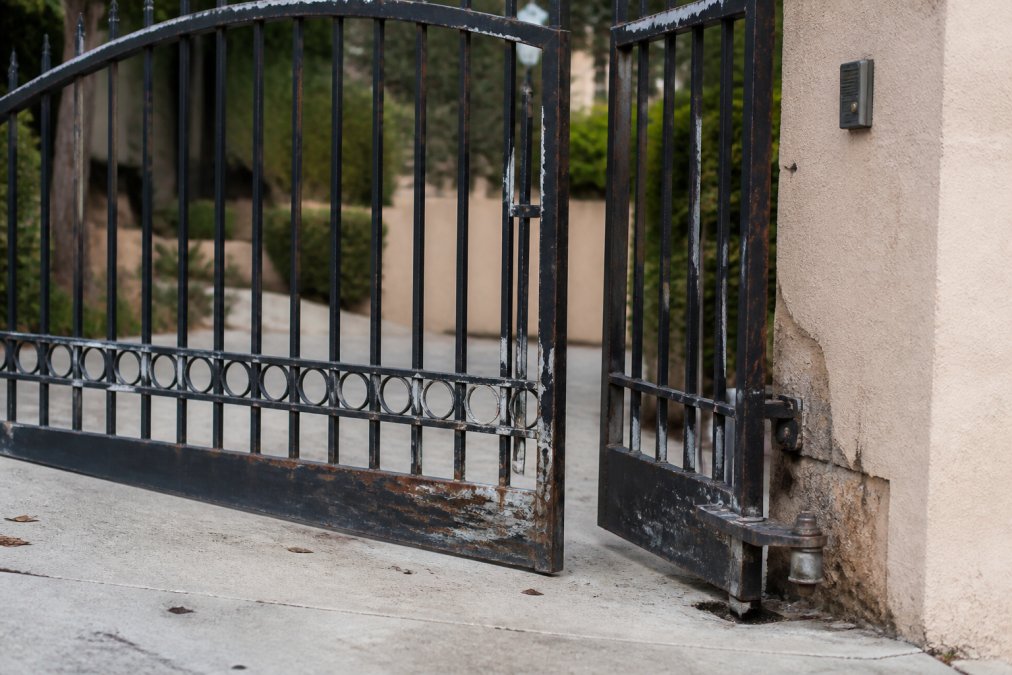
Your gate is the most vulnerable point of any fence. Invest in heavy-duty gate hardware, including tamper-proof hinges and a locking mechanism that cannot be lifted or pried open from the outside.
Hinge selection matters. Security-grade hinges use non-removable pins and through-bolted construction. For double gates, consider a center drop rod that secures the passive leaf to the ground.
Automated gate systems. Slide gates are inherently more secure than swing gates because they cannot be pushed open from the outside, but they require a concrete pad and a motor rated for the gate's weight. Both should include a manual release mechanism accessible only from the inside.
Landscaping as a Force Multiplier
A fence should never be the only layer of your perimeter defense. Dense, thorny shrubs planted two to three feet inside the fence line, varieties like barberry, holly, or pyracantha, create a secondary obstacle that makes it difficult to approach the fence, let alone climb it.
Gravel beds along the fence line create audible feedback, walking on loose gravel produces a distinctive crunch that carries at night, alerting you and your neighbors to movement near the perimeter.
Fence Site Preparation and Grading: The Critical First Step
This is where most residential security fence installations go wrong. Proper site preparation begins with land leveling and grading to ensure a stable, level base for post installation.
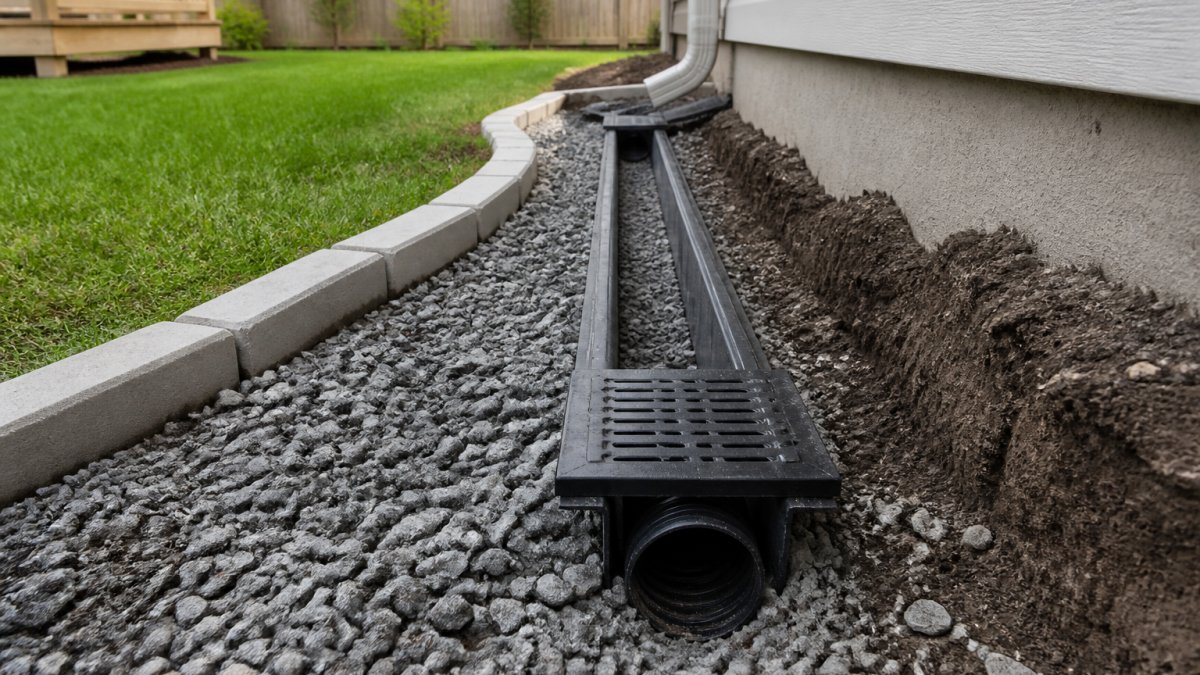
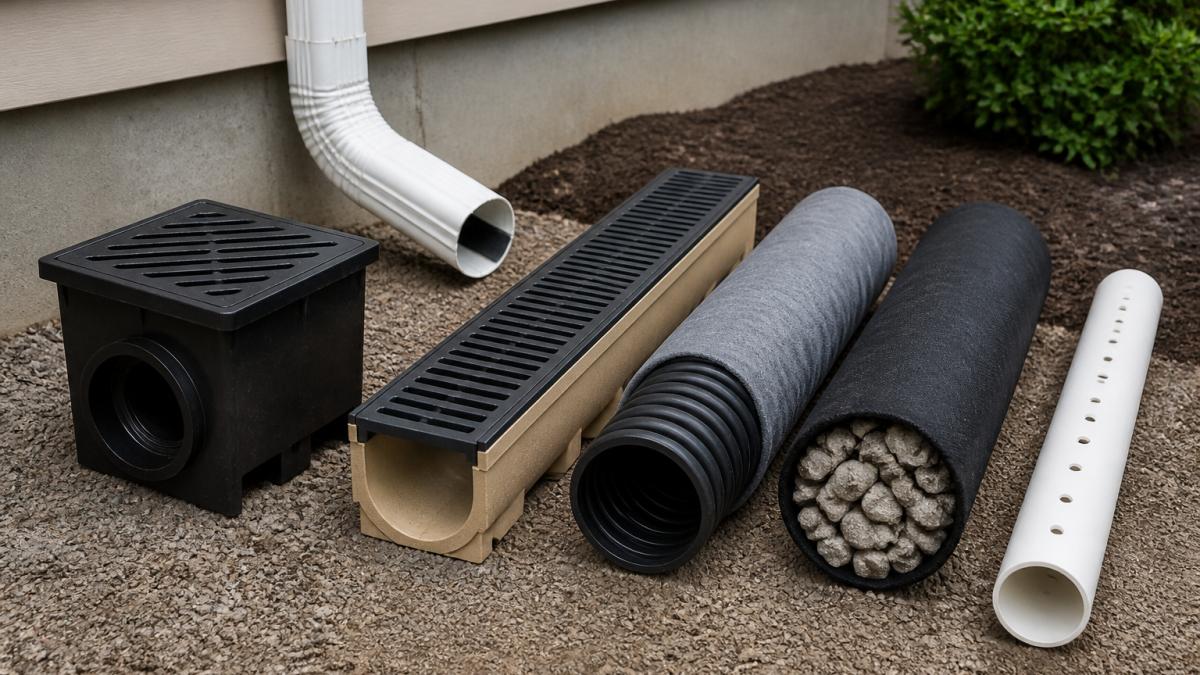
Drainage is equally critical. Standing water around fence posts accelerates corrosion and wood rot, dramatically shortening service life.
At OCAS Residential, we handle both land grading and fence installation, ensuring the ground is properly prepared before a single post is set.
Top Fence Installation Services for Security
OCAS Residential: Integrated Site and Fence Solutions
Our top pick is OCAS Residential because we treat your fence as part of a complete property system. Our custom fence and gate installation, repair, and replacement services provide secure residential fencing backed by professional land leveling and precision grading, ensuring a stable, properly drained foundation.
Beyond installation, we deliver complete site cleanup and debris hauling. For homeowners who want a single accountable partner from grading to the final gate latch, OCAS Residential is the most comprehensive choice.
Allied Fence & Security: Advanced Access Control
Allied Fence & Security specializes in high-security perimeter fencing with advanced access control integration. Their expertise in automated gate installation and maintenance makes them a solid pick for tech-forward homeowners, though the specialized hardware carries a higher cost.

Stonehenge Fences: Custom Wrought Iron Craftsmanship
Stonehenge Fences is known for custom wrought iron fabrication and high-quality residential security installations, making them a good fit for homeowners who prioritize aesthetics alongside security. Their service area is limited to specific regions.
DIY vs. Professional Installation Risks
The DIY route is tempting for budget-conscious homeowners, but the risks are substantial. Improper post installation is the most common failure: posts set at the wrong depth or in poorly compacted soil will shift, causing gates to bind and panels to sag.
A professional understands zoning ordinances, obtains the necessary installation permit, and knows how to handle property line disputes. They have the equipment for proper site assessment and grading, and they carry insurance that protects you if something goes wrong.
Conclusion: Securing Your Property Perimeter
Choosing the best fence installation for residential security means looking beyond the material and considering the complete system: the foundation, the reinforcement features, and the gate hardware that controls access. A fence is only as strong as its weakest point, the ground beneath it or the latch on the gate.
OCAS Residential handles the entire process from start to finish, from land leveling and precision grading to custom fence and gate installation. Schedule a free estimate today and get a fence that actually secures your home.
Frequently Asked Questions
What is the best fence type to deter intruders?
For maximum deterrence, ornamental steel or wrought iron fences are top choices. Their climb-resistant vertical bars and robust construction are difficult to breach. The best choice depends on your property and needs. Combining a sturdy material with anti-climb features and a secure gate offers the strongest defense.
Do high fences deter burglars?
Yes, high fences are a proven deterrent. A fence height of 6 feet or more makes it physically harder to climb and creates a significant psychological barrier. Most break-ins are opportunistic, and a tall, solid fence signals that your property is a difficult target. Be sure to check local zoning ordinances for height restrictions before installing.
How does professional site preparation affect fence longevity and security?
Proper fence site preparation and grading are crucial. A professional will ensure the ground is level and properly compacted before setting posts. This prevents posts from shifting or sinking over time, which can compromise the fence's structural integrity. Correct grading also prevents water pooling around the base, which causes corrosion and rot, ensuring your fence stays strong for years.
Can adding a gate improve my residential fence security?
Absolutely. A gate is the primary access point, so upgrading it is vital. A self-closing, self-latching gate with a keypad or smart lock adds a strong layer of access control. Ensure the gate is as tall as the rest of the fence and uses heavy-duty hinges and hardware to prevent forced entry.
This article was written using GrandRanker